
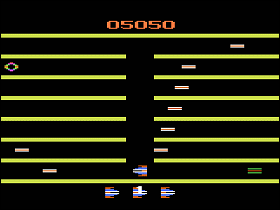
 The Game: Players pilot a ship trapped in a maze of vertically stacked level, teeming with aliens who are all deadly to the touch. The good news is that the ship has an inexhaustible supply of ammo. The not-so-good news is that the bad guys have an inexhaustible supply of bad guys. Players have to keep the ship from colliding with the enemy, while shooting at the enemy and watching out for split-second opportunities to grab any bonus items that may make a fleeting appearance. Just one word of caution: the prizes turn into smart bombs if you wait too long to go pick them up. (20th Century Fox, 1982)
Memories: Similar in execution to other “vertical shooters” like Ram It!, Turmoil has speed on its side, along with the cruel twist of forcing the player to retrieve bonuses that may blow up in his face.
 The Game: Your Vanguard space fighter has infiltrated a heavily-defended alien base. The enemy outnumbers you by six or seven to one at any given time (thank goodness for animated sprite limitations, or you’d be in real trouble!). You can fire above, below, ahead and behind your ship, which is an art you’ll need to master since enemy ships attack from all of these directions. You can’t run into any of the walls and expect to survive, but you can gain brief invincibility by flying through an Energy block, which supercharges your hull enough to ram your enemies (something which, at any other time, would mean certain death for you as well). At the end of your treacherous journey lies the alien in charge of the entire complex – but if you lose a life at that stage, you don’t get to come back for another shot! (Atari, 1982)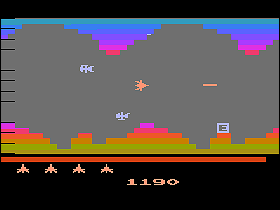

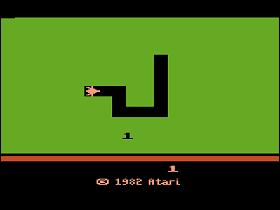
 The Game: As intrepid (and perpetually happy) adventurer Winky, armed only with a bow and arrow, you’re on a treasure hunt of the deadliest kind. HallMonsters try to stop you at every turn, and their minions guard the individual treasures that lie in the rooms of the maze. You can kill the smaller creatures (though their decomposing remains are still deadly to touch), but the HallMonsters are impervious to your arrows – and you’re lunch. (Coleco, 1982)
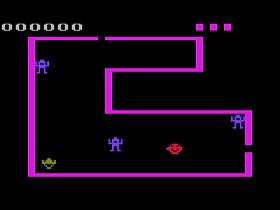 The Game: Trapped in a maze full of HallMonsters, you are adventurer Winky, on a mission to snatch incredible treasures from hazardous underground rooms inhabited by lesser beasts such as re-animated skeletons, goblins, serpents, and so on. Sometimes even the walls move, threatening to squish Winky or trap him, helpless to run from the HallMonsters. The deeper into the dungeons you go, the more treacherous the danger – and the greater the rewards. Just remember two things – the decomposing corpses of the smaller enemies are just as deadly as the live creatures. And there is no defense – and almost never any means of escape – from the HallMonsters. (Coleco, 1982)
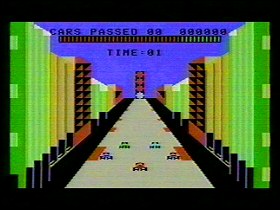 The Game: It’s pretty straightforward…you’re zipping along in your Formula One race car, trying to avoid other drivers and obstacles along the way while hauling a sufficient quantity of butt to win the race. (Coleco [under license from Sega], 1982)
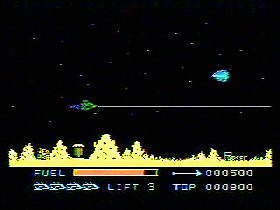 The Game: You control a space patrol fighter cruising over the surface of a planet. Alien attackers swarm on the right side of the screen and strafe you, and you must get out of the way of their laser fire and return some of your own; the more enemy ships you allow to safely leave the screen, the more you’ll have to deal with when they re-enter from the right side of the screen. Avoid their fire, avoid colliding with them, and avoid slamming into the ground, and you might just live long enough to repel the invasion. (Texas Instruments, 1982)
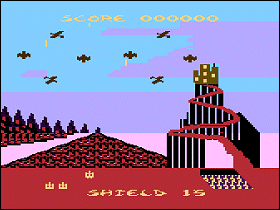 The Game: Hellish flying demons try to formation-dive your well-armed, devil-fryin’ vehicle at the bottom of the screen. Each time you knock one of this gargoylesque beasties out of the sky, they drop a piece of a bridge you must drag over to the appropriate spot on the screen. When you’re close to completing the bridge, the Prince of Darkness sends in some heavier artillery – a spooky floating demon head who spits fire at your cannon – to do away with you. Once you’ve toasted the flying meanies out of the sky and cross the bridge, it’s time to do battle with Satan himself. (CBS Video Games, 1982)
 The Game: Players control a caterpillar, hungrily navigating a twisty maze of twigs and branches to eat leaves. Sometimes the player’s caterpillar will have reached a dead end, but this is not revealed until the leaf covering that dead end is consumed. Other insects swarm around the caterpillar, trying to catch and eat it for themselves. At the beginning of each “life” the player can press a button, giving the caterpillar a brief bug-zerker rage, allowing it to eat its enemies for a change, but this change is short-lived; special flowers must be consumed to regain the ability. Once all of the leaves have been eaten in an entire maze (which takes up more than a single interlinked screen), a “home” appears, into which the caterpillar must be successfully guided for transformation into a butterfly. Then the player is given a new caterpillar to guide and a new maze to navigate. (Valadon Automation [under license to Iti S.A.], 1983)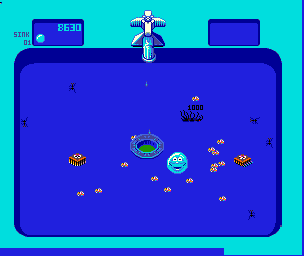

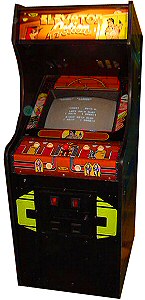 The Game: Love in an elevator, it’s not. As a daring spy, you break into a top secret enemy facility, trying to grab vital secrets and evade or kill as many enemy agents as you can. Your only means of getting from floor to floor through most of the game is via the elevator – which gives you an advantage and also makes you vulnerable. (Taito, 1983)
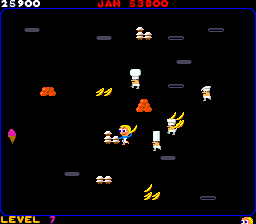 The Game: You are Charley – but you don’t have the Golden Ticket. Instead, what you have is a playfield littered with immobilizing potholes, lots of food, and four feisty chefs (is there a different word for the plural of “chef”?). Charley Chuck can pick up handfuls of food and fling them at any one of his opponents, but keep in mind that they can do the same. Charley’s ultimate goal? Reach the yummy ice cream cone at the opposite end of the screen without falling victim to any of the above. To do any less causes every piece of food on the screen to hurl itself at Charley. (Atari, 1983)
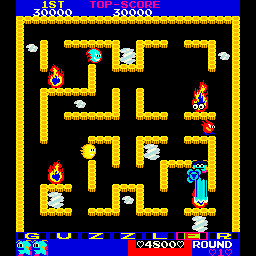 The Game: As a fluid little fellow, you zip around a maze flooded with flaming foes who’ll fry you with fire without fair warning. However, since water can put out fire, you can belch forth a mighty stream of water at your enemies, extinguishing them instantly. However, you’re only a little Guzzler, so you only contain a certain amount of water. You replenish yourself very slowly, but you can gobble up clouds full of moisture or drink from a fountain that occasionally appears at the center of the maze to refill yourself more quickly. And some fires are bigger than others, and putting them out will accordingly take more out of you. And you do eventually run out of clouds… (Tekhan, 1983)
 The Game: Marvin built a maze on two levels, with habitrail-style tunnels to take him from the first floor to the second and back again, and all was well until the Robonoids moved in and took over. Now they’re out to evict Marvin from his own turf! It’s up to you to guide Marvin through his maze, using cunning one-way bridges to escape from the Robonoids and find the power-ups he needs to zap them. Marvin moves on to the next maze (and the next level of difficulty) only by clearing this maze of power-ups and dots. (SNK, 1983)
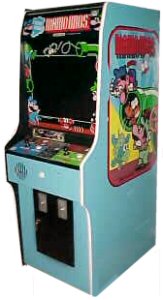 The Game: Twin brothers Mario and Luigi give up the illustrious life of ape-chasers and damsel-rescuers for their original line of work… plumbing. But this doesn’t mean the job’s any less dangerous. Killer lobsters and turtles abound in the sewer system (well, isn’t it that way everywhere?), along with airborne fireballs not unlike the foxfires in the original Donkey Kong. Another key event in this game? Nintendo solidifies its near-total dominance of the video game industry for the better part of the following decade and a half. (Nintendo, 1983)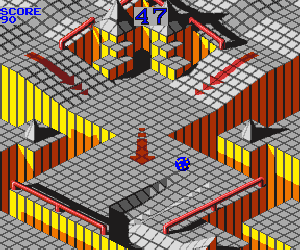
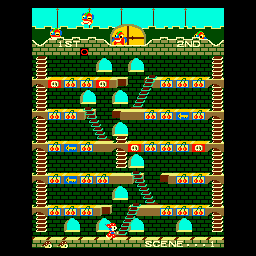 The Game: As cuddly clown Mr. Do, you’re scrambling to squish all the unicorns who are invading your castle. You can repel them momentarily with your clown hammer, but you can only squish them permanently by knocking a brick out from the floor above. Most bricks contain cherries, but some also contain keys that unlock the door at the top. When that door is completely unlocked, touching it will transform the unicorns into letters that make up the word EXTRA. As with Mr. Do!, collecting all five letters merits an extra “life.” Clearing the screen of monsters or cherries advances you to the next level. (Universal, 1983)
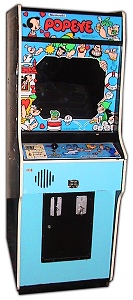 The Game: Well, blow me down! Popeye the sailor man gets his own video game. On level one, you’re trying to catch Olive Oyl’s falling hearts before they descend to sea level and are lost, while ducking Bluto’s punches at the same time. A can of spinach appears every so often, giving you the opportunity to read the big bully the riot act (comic strip-style, of course). On level two, the falling hearts are replaced by falling musical notes, and you’ll need Wimpy’s hefty help to keep Swee’Pea from drifting away on a balloon. (Nintendo, 1983)
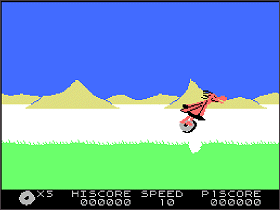 The Game: As beleaguered caveman B.C., you’ve just discovered the wheel. That’s the good news. The bad news is that, on the same day that you harness mechanical motion for the first time, you’re also going to discover the traffic accident. Jump over holes in the ground, rocks and rolling boulders, and duck under tree limbs – and then you’ve got to survive showing your new evolutionary step off to the Mrs.! (Sierra On-Line, 1983)
 The Game: You’re alone in a maze filled with armed, hostile robots who only have one mission – to kill you. If you even so much as touch the walls, you’ll wind up dead. You’re a little bit faster than the robots, and you have human instinct on your side…but even that won’t help you when Evil Otto, a deceptively friendly and completely indestructible smiley face, appears to destroy you if you linger too long in any one part of the maze. The object of the game? Try to stay alive however long you can. (Atari, 1983)
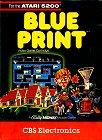 The Game: You are the intrepid, barbershop-quartet-suited J.J. (hey, it’s better than being O.J.!), out to save a damsel in distress from a pursuing monster. How does a guy in a little striped suit do this? By building a mobile, tennis-ball-launching contraption to dispatch said dastardly monster, naturally. The catch? The eight pieces of your mechanical creation are hidden somewhere among ten little houses in a maze – and those houses that don’t contain parts of your machine contain a bomb that must be dumped into the bomb pit immediately (else they’ll explode and kill J.J.). Critters also roam the maze to annoy you, including one pesky monster who will prematurely jump on the “start” button, rattling your still-unfinished machine to bits. If you don’t build your Rube Goldberg gizmo in time, the monster catches the damsel and you lose a life. (CBS Electronics, 1983)
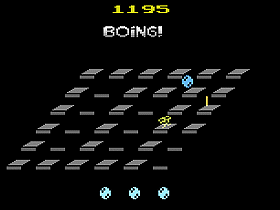 The Game: You’re a bubble bounding around a series of platforms, changing the color of every segment on which you land. Your job is to change the color of the entire playing field while avoiding everything else, including an equally mobile needle that has a point to make. If you run into your adversaries too many times, I hate to burst your bubble, but the game’s over. (First Star Software. 1983)
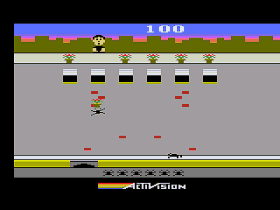 The Game: You are Potsy, a flowerpot-chucking tenant in a building being overrun by spiders. As they come up the walls, hurl potted plants at ’em to squish them before they can climb into the windows; if too many spiders make it
  The Game: As the offspring of the mighty monkey, it’s up to you to scale vines and chains, avoid mobile traps, occasionally grab some yummy fruit (since when is a little ape on Pac-Man’s diet?), and get to the key or keys that will free your papa. (Coleco, 1983)
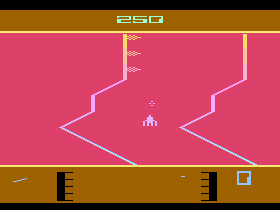 The Game: Man a biological “spaceship” and get ready to shrink down to microscopic size – you’re going on a voyage through the human body! Blasting away viruses and disease cells, and leaving the body’s natural defenses intact, you’re going to give the immune system a little bit of a boost – at least until a disease cell takes out your micro-ship. Based on the 1966 movie of the same name. Raquel Welch not included. (20th Century Fox Video Games, 1983)
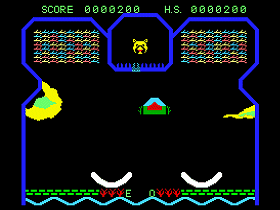 The Game: The water is rising! You’re all that stands between the animals and rising floodwaters. Using a pair of paddles, you have to keep a projectile moving without letting it knock a hole in the seawall behind you; if too many holes are blasted through the wall, the game will be over and the water will pour in. (Spectravideo, 1983)
 The Game: In a faithful home version of Sega’s original arcade game, you’re a frog trying to cross a highway, and then safely hop across the backs of logs and turtles – while avoiding alligators, snakes and otters – all to get home at the top of the screen. (Parker Brothers, 1983)
 The Game: As the pilot of a solo space fighter, you take on several different varieties of alien attacks masterminded by those pesky, ever-present Gorfian robots. (Coleco, 1983)
 The Game: Feel like literally “playing” the stock market? This game allows you to do so with varying degrees of accuracy, ranging from level one – simple trading – to level four, which allows buying on margins, prime rate interest calculations, and numerous other complications. A ticker across the top of the screen gives the current values of several stocks and commodities, while a ticker running across the center of the screen gives the latest news updates. The nature of that news can have drastic effects on the stocks available for trade, ranging from the sometimes silly (“electronic foot massager increases worker productivity”) to the frighteningly prophetic (“war threat in the Middle East”). (North American Phillips, 1983)
 The Game: Don’t be too eager to say “By the power of Greyskull,” because there’s one problem: Skeletor has wrested the power of Castle Greyskull for himself, and seems none too keen on giving it back. As He-Man, the player is tasked with reaching the castle via a flying vehicle, shooting down fireballs (and, if possible, ensnaring Skeleton in traps from above) along the way; provided He-Man doesn’t use up all of his fuel in the aerial fight, he lands at Greyskull and must dodge Skeletor’s fiery projectiles in order to do battle with the ghastly one. Only one will win. (Mattel Electronics, 1983)
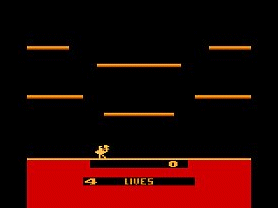 The Game: As a fearless pile of buzzard bait encased in armor, you pilot your trusty steed – who happens to be an ostrich, by the way – in an effort to impale your opponents – who also happen to be riding ostriches – before they can lance you. Other dangers include a pterodactyl who periodically arrives to thin out the ranks of on-screen warriors if things are taking too long, and platforms that disappear under your feet, plunging you into a sea of molten lava. (Atari, 1983)